Kids learning and parenting apps: what 16 quiz funnels show
Apps that teach children to read or do math, and programs that teach parents to stay calm, sell to the same person: a parent on a phone. Most of them do it through a quiz. We walked 16 of these quizzes to the paywall as a new visitor would, and compared what they ask and what they charge.
Data as of · NextAngle research
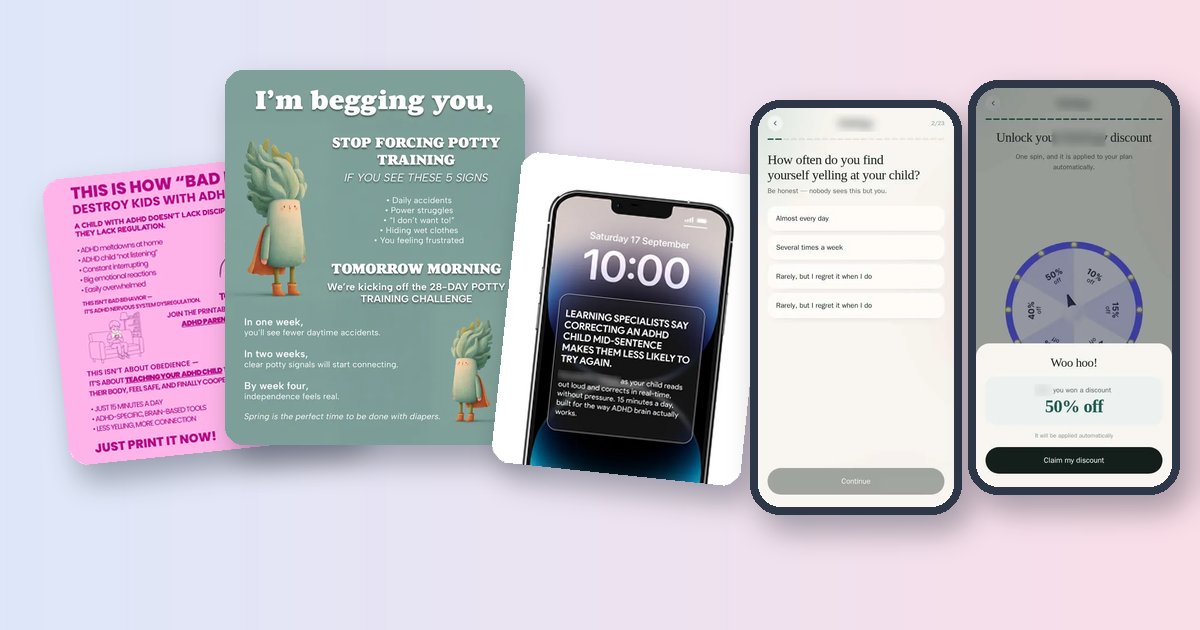
Two products, one buyer
Nine funnels in the sample sell learning for the child: reading lessons, math, homework help, speech, piano. Seven sell a program for the parent: stop yelling, potty training, ADHD, a sensitive child, a teenager. The buyer is the same, and so is the opening: in nine of the 16 funnels the first question is the child's age or grade.
The ads speak to the parent's worry rather than to the child: meltdowns at 7 PM, accidents, a child who "doesn't listen", the fear of being a bad parent.
- Proof from another parent: a child reading at a higher grade level after a few months.
- A diagnosis or a label: ADHD, sensory issues, a strong-willed child.
- An expert claim: "learning specialists say…".
- A challenge that starts tomorrow: 15 minutes a day, 28 days — the same template as fitness challenges.
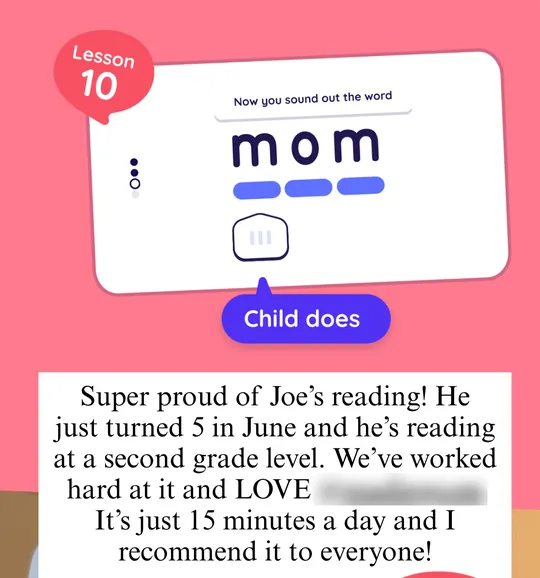
A lesson screen ("now you sound out the word: mom") and a parent's post: a five-year-old reading at a second-grade level, 15 minutes a day.
Why it works: the product and a parent's voice in one picture; it has run for eleven months.
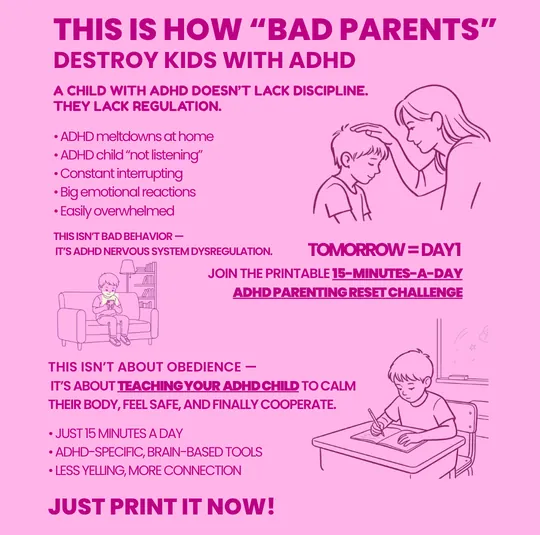
This is how "bad parents" destroy kids with ADHD — join the printable 15-minutes-a-day reset challenge.
Why it works: a provocative headline, a checklist of symptoms the parent recognizes, and a "printable" challenge that starts tomorrow.
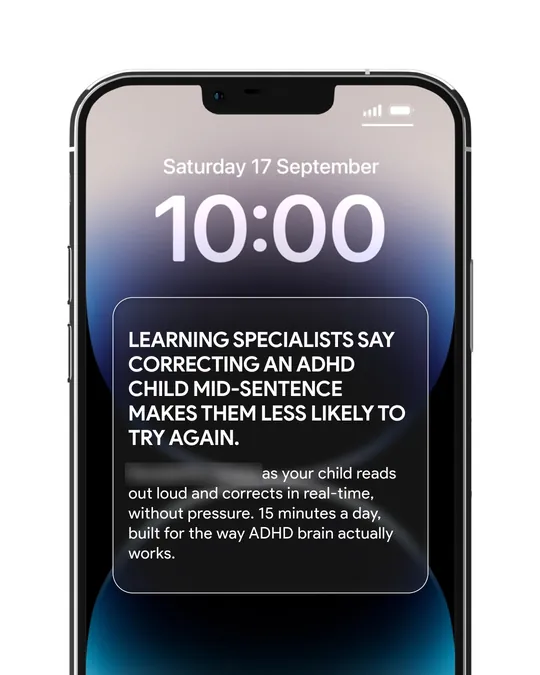
Learning specialists say correcting an ADHD child mid-sentence makes them less likely to try again.
Why it works: an expert claim dressed as a phone notification; the app is introduced as the gentler way.
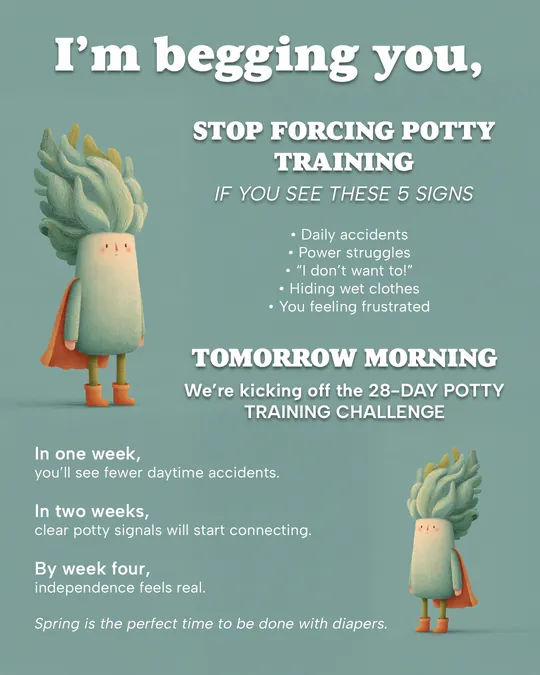
I'm begging you, stop forcing potty training if you see these 5 signs — the 28-day challenge starts tomorrow morning.
Why it works: the same "challenge starts tomorrow" template as fitness ads, with a promise by week one, two and four.
Shorter quizzes than fitness or AI courses
The median quiz took 28 to 29 screens to reach the paywall — fewer than the 43 of fitness apps and the 32 of AI course apps. The range is wide: a math club shows its result after six screens; a program to stop yelling asks 24 questions on 41 screens.
Every funnel asks for an email before the paywall, four screens before it on the median. One asks for the parent's name and email on the very first screen; four ask on the screen right before the plans.
The child's name on the paywall
Seven funnels of five apps ask for the child's first name, next to the email. From then on the name is everywhere: "Where should we send [name]'s plan?", "Ready to teach [name] how to read?", "Unlock [name]'s reading potential", a now-and-in-four-weeks picture with the name over it, even a promo code with the name in it. A parenting program does the same with the parent's own name.
Anatomy of one funnel
A plan to stop yelling shows how a parenting quiz works. The first screen asks the child's age; then come 23 numbered questions about the parent, not the child: how often you yell, what happens inside you before you do, which thought hurts the most afterwards, whether you speak to your child the way your parents spoke to you. Between them, info screens with real photos answer back ("Most parents yell. Almost all of them regret it."). The email comes on screen 37 of 42, and a wheel of fortune hands out the discount before the paywall.
Eight of those screens
As our walk saw them, on a phone-sized screen. The info screens with photos of parents and children are left out.
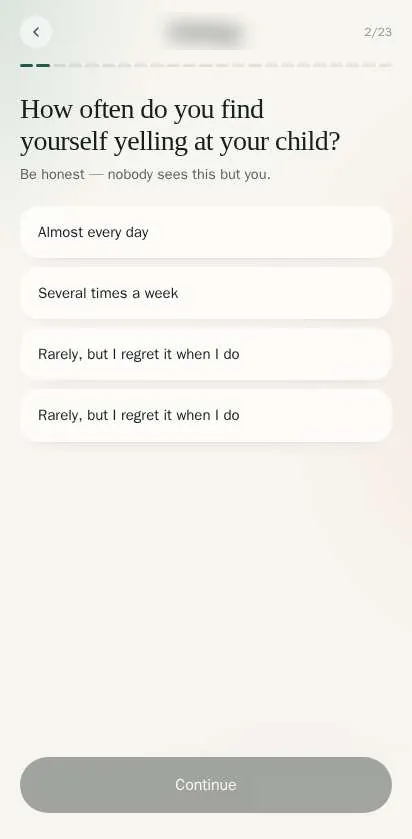
5 / 42. "Be honest — nobody sees this but you." The problem, asked head-on.
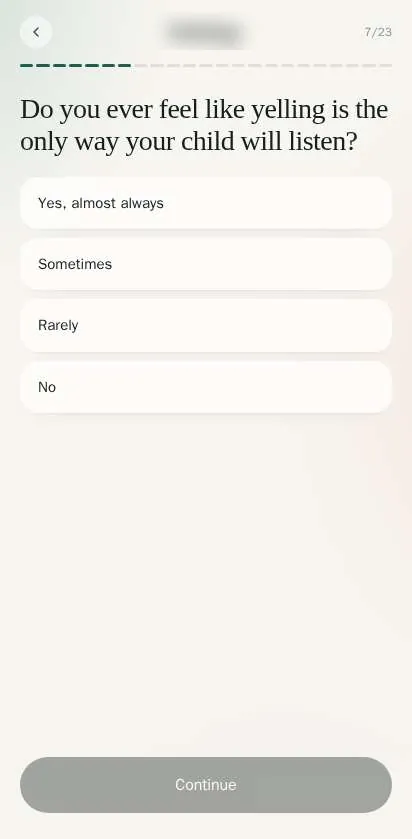
11 / 42. The quiz puts the parent's own doubt into words.
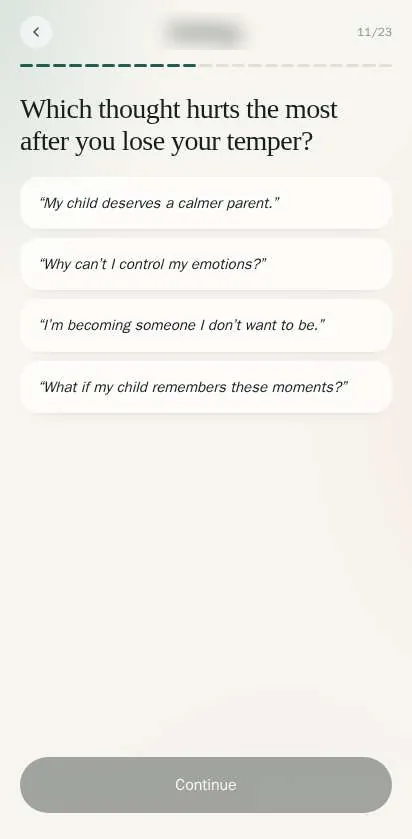
16 / 42. Answers written as the parent's inner voice.
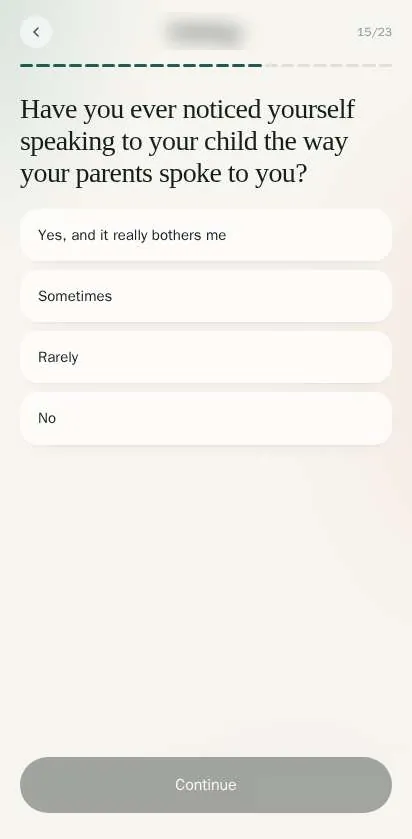
22 / 42. The deepest question comes in the middle.
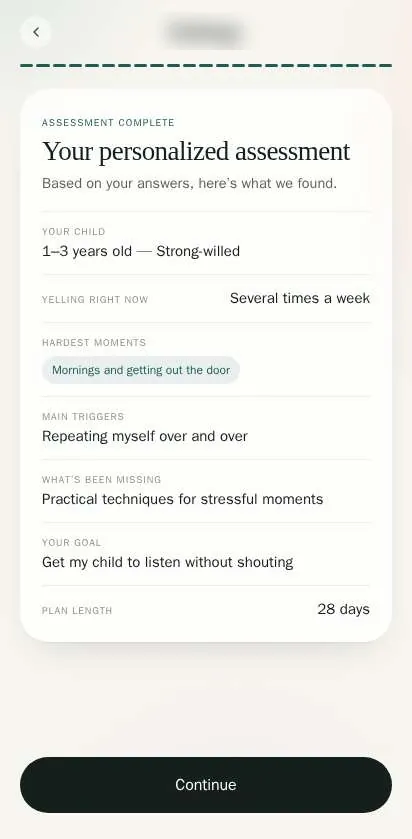
36 / 42. The answers come back as a profile, with a 28-day plan length.
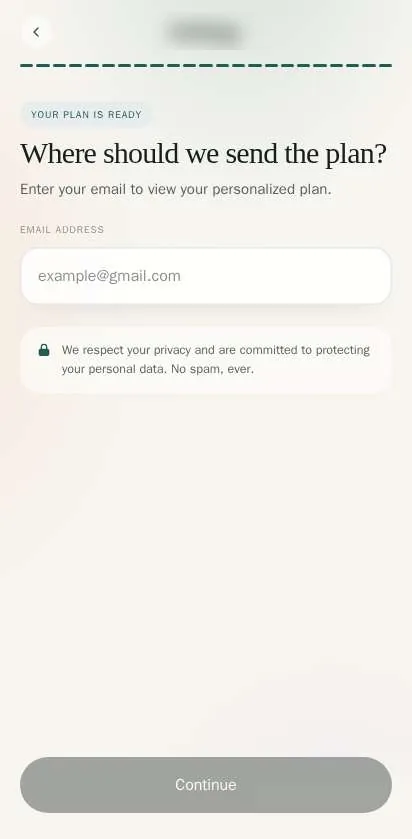
37 / 42. The email, five screens before the paywall.
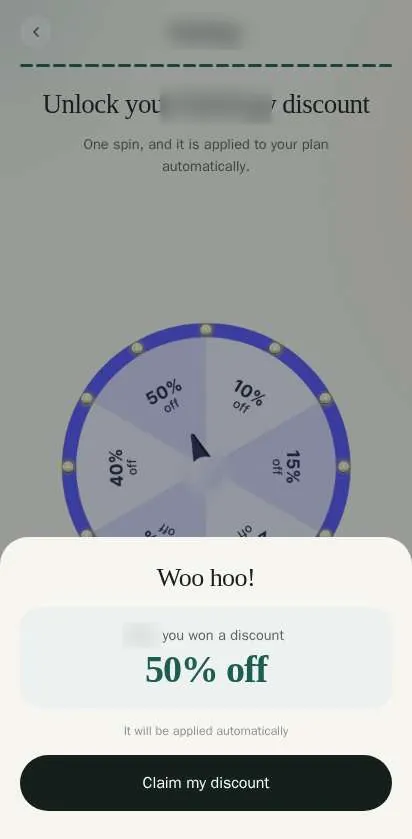
41 / 42. A wheel of fortune decides the discount — it lands on 50%.
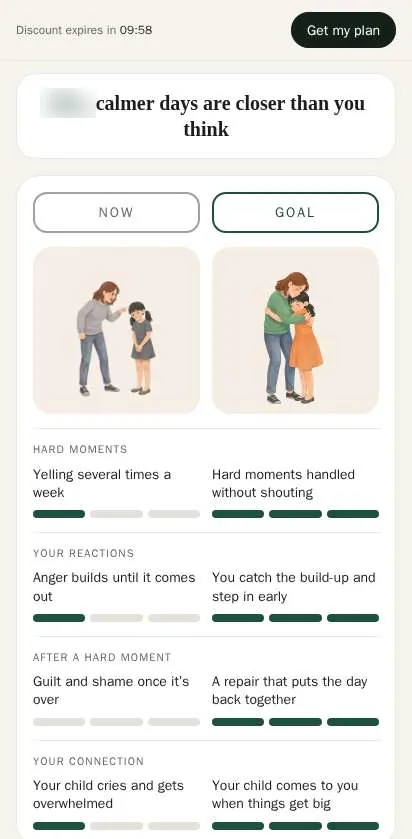
42 / 42. The paywall opens with the parent's name and a now-and-goal picture.
Less than $7 to start, two of them free
The median payment today was $6.99. Two learning apps charge nothing today — a 30-day and a 7-day free trial — and a program for dads asks $1 for a week. The most expensive starts are about $20 for the first four weeks of a parenting program.
Six of the eight paywalls we looked at screen by screen run a countdown of about ten minutes above the plans, usually next to "50% discount reserved for you".
Learning apps cost less than parenting programs
After the intro, the two kinds of apps part ways. Learning apps cost about $25 a month on the median, and five of the nine offer a yearly plan — one reading app asks $74.94 for the first year against $12 for a single month. Parenting programs cost about $40 per month or four weeks on the median, and only one of the seven sells a year, at $180.
Several parenting programs also borrow the price grid of fitness and AI course apps: short plans from a week to a few months, with the middle one marked most popular and pre-selected.
Three plans and a wheel of fortune
The stop-yelling program shows the parenting grid: $6.94 for the first week, $19.99 for the first four weeks (most popular, pre-selected), $39.99 for twelve weeks — each renewing at twice the intro price. The 50% the wheel "won" is exactly the markdown on every plan.
What to take from it
- Ask the child's name and use it: on the plan, on the paywall, in the promo code.
- Write the questions in the parent's own voice — the doubts they would not say out loud.
- Learning apps can sell a year; parenting programs sell four weeks at a time. Test the yearly plan before copying the weekly grid.
- A free trial is rare here: two funnels of 16 charge nothing today.
How we collected this
NextAngle visits the landing pages of the ads it collects from the Meta Ad Library, recognizes quizzes and walks them to the paywall from a clean browser, with a test identity, and never pays. This page uses the funnels of kids learning apps and parenting programs walked between October 16 and November 12, 2026, for ads seen in the US, whose paywall plans we could read: 16 quizzes of 13 apps. A/B variants of the same quiz count once; a kids gadget sold at $139 is left out. A screen where the visitor picks an answer and then taps Continue counts once. It is a sample of what we visited, not the whole market.
Questions
How much do kids learning apps cost?
In this sample a month costs about $25 on the median after any intro price, from $12.49 to $39.99. Five of nine learning apps offer a yearly plan, often at half price or less for the first year — for example $74.94 for the first year of a reading app against $12 for a single month.
How much do parenting apps cost?
Parenting programs cost about $40 per month or four weeks on the median after the intro, from $15 to $59.99. They usually start with a cheap first week ($1 to $7) or a first four weeks at about $20.
Do kids reading apps have a free trial?
Some do: two of the 16 funnels charge nothing today, with a 30-day and a 7-day free trial. The others take a first payment, $6.99 on the median.
Why does a kids app quiz ask for my child's name?
To personalize the plan and the paywall. Seven funnels of five apps ask for the child's first name next to the email and then show it on the plan, the paywall and even the promo code.
How long is a quiz for a kids learning or parenting app?
28 to 29 screens on the median, from 6 to 41. Parenting programs ask more about the parent than about the child.
What is the "spin the wheel" discount on app paywalls?
A screen before the paywall where the visitor spins a wheel of discounts. In the funnel we walked it landed on 50% — the same intro discount the paywall shows on every plan.
Which ads do parenting apps run on Meta?
Ads aimed at the parent's worry: ADHD and meltdowns, potty training, yelling, a child who doesn't listen — often as a "challenge" that starts tomorrow, 15 minutes a day for 28 days.
Read next
Fitness app quiz funnels
22 paywalls of fitness coaching apps: screens, prices and angles.
AI course app quiz funnels
20 paywalls of apps that teach AI tools, and one quiz under three brands.
Paywall price tracker
Intro prices, trials and plans of subscription funnels.
See every kids and parenting funnel and its paywall
Then Pro at $99 a month, cancel any time. During the beta we let people in from the waitlist.
Join waitlist